Buy referencez.eu ?
We are moving the project
referencez.eu .
Are you interested in purchasing the domain
referencez.eu ?
domain@kv-gmbh.de · 0541-91531010
Buy referencez.eu ?
How can adverbial clauses be transformed into adverbial phrases?
Adverbial clauses can be transformed into adverbial phrases by removing the subject and verb of the clause and keeping only the modifying words. This results in a shorter phrase that still conveys the same information as the original clause. For example, the adverbial clause "When the sun sets" can be transformed into the adverbial phrase "At sunset." This transformation helps to simplify sentences and make them more concise. **
What are adverbial clauses and what are adverbial determinations? Help!
Adverbial clauses are groups of words that function as adverbs in a sentence, providing information about time, place, manner, or reason. They often begin with subordinating conjunctions such as "when," "where," "how," or "why." Adverbial determiners, on the other hand, are words or phrases that modify a verb, adjective, or other adverb by providing additional information about time, frequency, degree, or manner. They can include words like "often," "very," "soon," or "almost." Both adverbial clauses and adverbial determiners help to add detail and specificity to a sentence. **
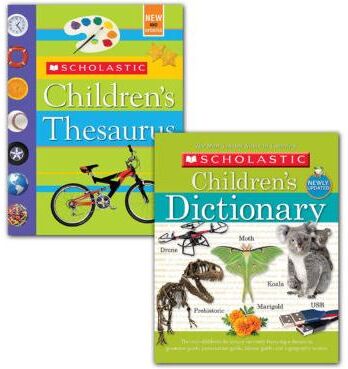
Similar search terms for Adverbial
Top-Angebote
Products related to Adverbial:
-
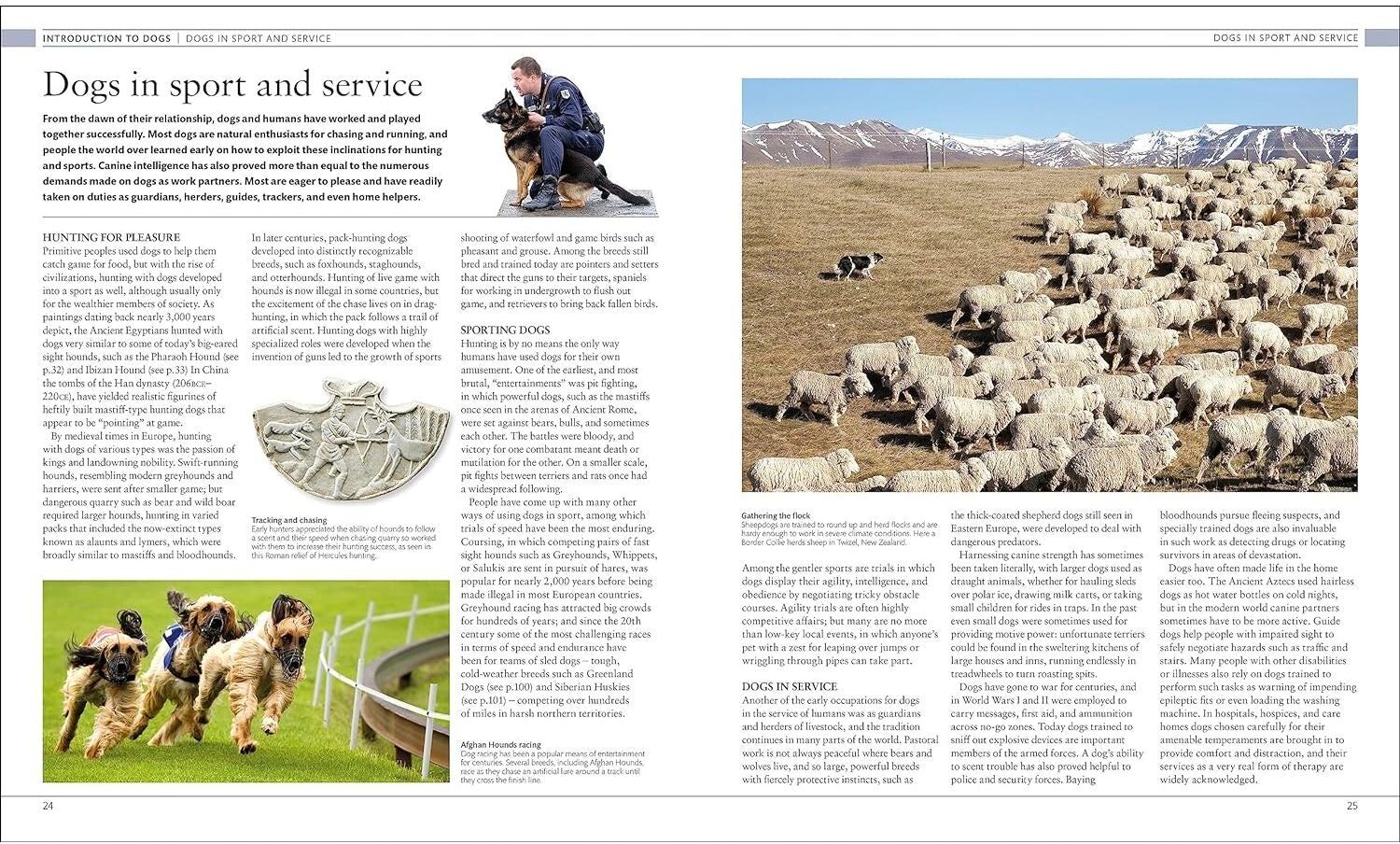
The Dog Encyclopedia: The Definitive Visual Guide (DK Pet Encyclopedias)Explore the history and variety of our most faithful companions in this collection of over 400 different dog breeds. For centuries, dogs have been adored for their unswerving loyalty, and this new edition of The Dog Encyclopedia perfectly celebrates the special relationship that binds humans with our four-legged friends. Starting with their history, evolution, and anatomy, this brilliant book about dogs puts on a show of dogs in art and advertising, sport and service, and religion and culture, as famous dogs in fiction line up alongside heroic helpers. The catalogue introduces more than 400 dog breeds arranged in traditional categories, from primitive and working dogs to companion dogs and scent hounds. Every entry includes glorious photographs and fact-packed profiles detailing the individual character, compatible owner traits, and breed-specific advice. Dive straight into this dog book, which offers:- A fully-illustrated guide to canine anatomy and body systems. - A catalogue of internationally recognized dog breeds. - Annotated images that highlight the typical characteristics of every featured breed. - Boxed topics on record breakers, canine film stars, and heroic war dogs add a fascinating degree of detail. Additionally, the book offers expert information on everything from exercising and feeding your dog to grooming and puppy training, along with a section on care to help you identify and deal with any canine health problems. Combining fabulous photographs with information on the latest breeds, historical facts, and advice on everyday care, The Dog Encyclopedia is an indispensable owner's guide and a useful reference for professionals.16,99 £*Shipping: 2,99 £Secure redirect to the provider
-
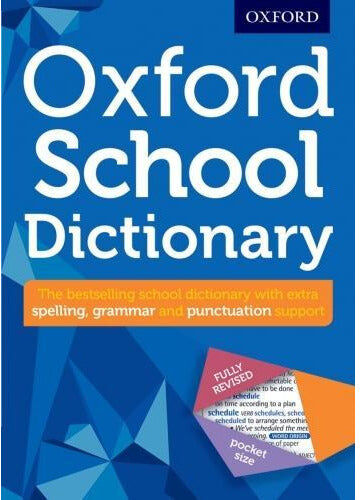
OXFORD UNIVERSITY PRESS Oxford School Dictionary - Oxford DictionaryOxford School Dictionary Description A major new edition of the trusted; bestselling; comprehensive Oxford School Dictionary with new curriculum support. This fantastic new edition will boost your children's vocabulary with new words and meanings from across the curriculum. A helpful new spelling; grammar and punctuation section is included to enhance language skills and bring the dictionary up to date. What makes it the best? It is uniquely powered by the Oxford Children's Corpus; the largest bank of children's language in English; so you can be confident that all entries are clearly written in child-friendly language that children actually understand. Each example is perfectly age-appropriate; making it easy and enjoyable for every child to use. New for this edition is a robust supplement on spelling; grammar and punctuation; giving targeted help with the tricky bits; making this dictionary the perfect tool to support children in their journey to become good readers and writers. As usual; it has been extensively trialled with schools; so you can be sure it is still the best dictionary for your children; in a handy pocket-sized format7,99 £*Shipping: 2,99 £Secure redirect to the provider
-
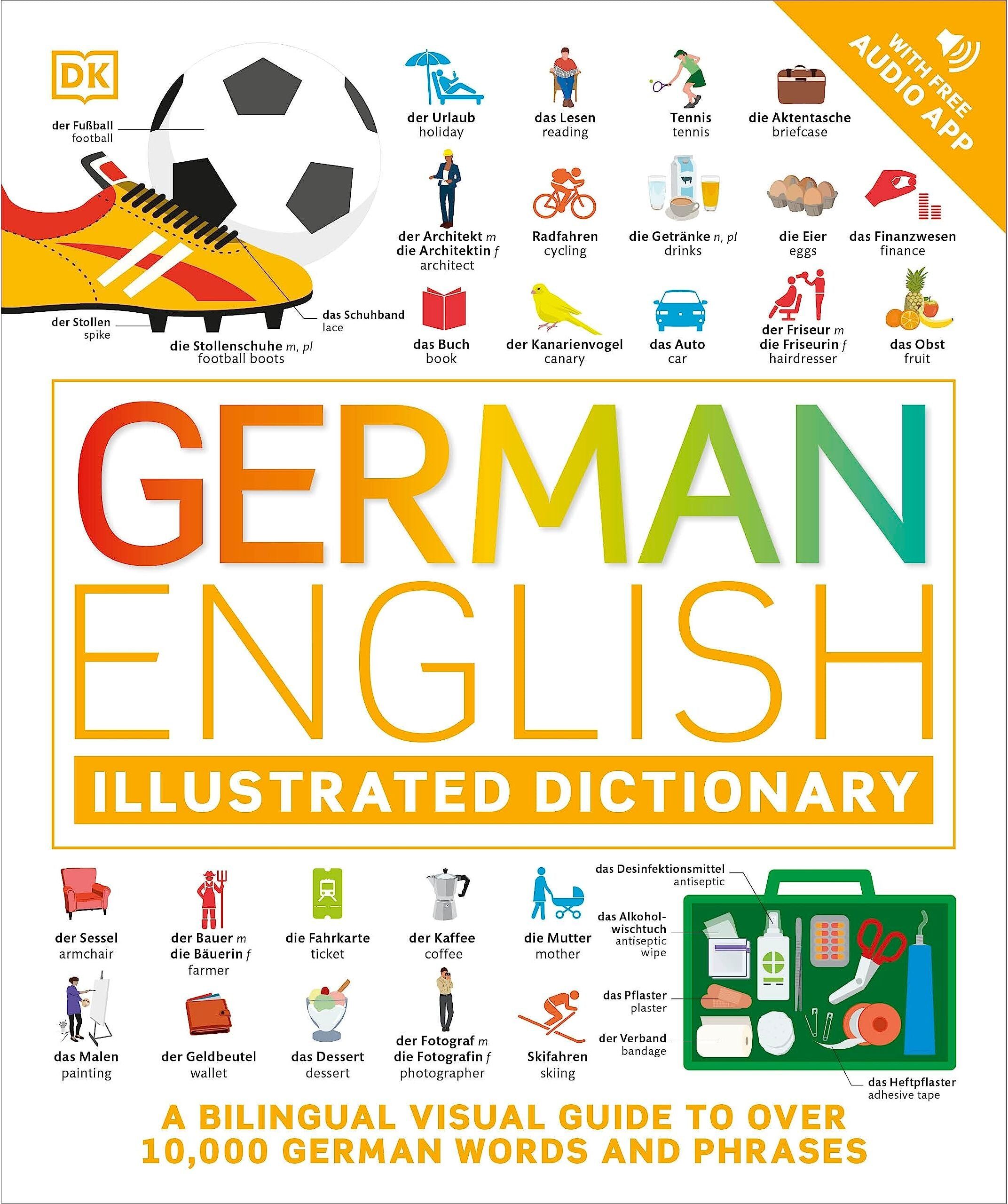
DK German English Illustrated Dictionary: A Bilingual Visual Guide to Over 10,000 German Words and PhrasesLearn more than 10,000 of the most useful words and phrases in German with this beautifully illustrated dictionary for German-language students. Building on the success of the English for Everyone course books and the Bilingual Visual Dictionary series, the German English Illustrated Dictionary uses crystal-clear illustrations to show the meaning of over 10,000 words of German vocabulary. The words are shown in a visual context in themed sections covering practical or everyday topics (such as shopping, food, or study), providing learners with all the vocabulary they need for work, travel, and leisure. Fancy becoming an expert in the language? Then open the pages of this German dictionary to discover:- A comprehensive guide to a wide range of useful German words and expressions. - Structured in clear sections based around a theme (e.g. sports, food and drink, transport). - Clear, attractive illustrations make the vocabulary easy to understand and remember. - Includes a beautiful illustration at the start of the section that sets the theme in context. German English Illustrated Dictionary is incredibly easy to use and can be used for self-study or as a reference in the classroom, and is suitable for learners at all levels, from beginner to advanced. Learning German vocabulary has never been easier with this visually stunning dictionary!12,99 £*Shipping: 2,99 £Secure redirect to the provider
-
OUP Oxford Oxford First Thesaurus: An illustrated thesaurus for children age 5+ (Oxford First Dictionaries)Help children build confident speaking and writing skills with the Oxford First Thesaurus - a vibrant, child-friendly thesaurus designed especially for ages 5 and up. Perfect for use at home or in the classroom, it supports early language development by encouraging children to explore new and adventurous vocabulary in a fun, accessible way. Key features include: • Perfect for ages 5+: Developed specifically for young learners to build early speaking and writing confidence • Supports vocabulary growth: Age-appropriate example sentences help children understand synonyms in real-life context • Engaging full-colour illustrations: Bright, 3D artwork helps bring vocabulary to life and makes learning fun • Easy to navigate: Clear alphabetical layout with alphabet thumb tabs and easy-to-use index so children can independently find the words they need • Powered by the Oxford Children's Corpus: Created using a database of real examples of children's writing ensure natural, relevant vocabulary • Perfect classroom or home companion: Works seamlessly alongside the Oxford First Dictionary (9781382076487) for complete early-language support6,99 £*Shipping: 2,99 £Secure redirect to the provider
-
How can adverbial phrases be used instead of adverbial clauses?
Adverbial phrases can be used instead of adverbial clauses to provide additional information about the verb, adjective, or adverb in a sentence. Adverbial phrases are often shorter and more concise than adverbial clauses, making them a more efficient way to convey the same information. For example, instead of saying "When the sun sets, we will go for a walk," you can use the adverbial phrase "At sunset, we will go for a walk." This simplifies the sentence while still conveying the same time-related information. **
-
How do you transform adverbial determinations into adverbial clauses? Please help.
To transform adverbial determinations into adverbial clauses, you need to add a subject and a verb to the adverbial determination. For example, the adverbial determination "after the party" can be transformed into the adverbial clause "after we left the party." This transformation allows the adverbial determination to function as a complete clause within a sentence. Additionally, you may need to adjust the tense and structure of the adverbial determination to fit the context of the sentence. **
-
What are adverbial particles?
Adverbial particles are words that are used to modify verbs, adjectives, or other adverbs. They are often used to indicate direction, location, or manner. In English, adverbial particles are commonly used in phrasal verbs, where they are combined with a verb to create a new meaning. For example, in the phrasal verb "look up," the adverbial particle "up" modifies the meaning of the verb "look." **
-
What is the difference between formulating an adverbial clause as an adverbial phrase and formulating an adverbial phrase as an adverbial clause? Aren't they the same thing?
Formulating an adverbial clause as an adverbial phrase involves expressing a clause (a group of words containing a subject and a verb) as a single adverbial phrase, typically by removing the subject and verb. On the other hand, formulating an adverbial phrase as an adverbial clause involves expanding a phrase (a group of related words without a subject and verb) into a full clause by adding a subject and verb. While both adverbial clauses and adverbial phrases serve to modify verbs, adjectives, or other adverbs, they are not the same thing due to their structural differences and the presence or absence of a subject and verb. **

How do adverbial clauses work?
Adverbial clauses function as adverbs within a sentence, providing information about time, place, manner, condition, purpose, or reason. They often begin with subordinating conjunctions such as "when," "where," "how," "if," "because," and "although." These clauses can modify verbs, adjectives, or other adverbs, adding detail and context to the main clause. Adverbial clauses can be placed at the beginning, middle, or end of a sentence, and they help to connect ideas and show the relationship between different parts of a sentence. **
What is an instrumental adverbial?
An instrumental adverbial is a type of adverbial that provides information about the means or instrument used to perform an action. It answers the question "how?" or "by what means?" For example, in the sentence "She cut the vegetables with a knife," the adverbial phrase "with a knife" is instrumental, indicating the tool used to perform the action of cutting. Instrumental adverbials are important for providing additional details about the action being described. **
Top-Angebote
Products related to Adverbial:
-
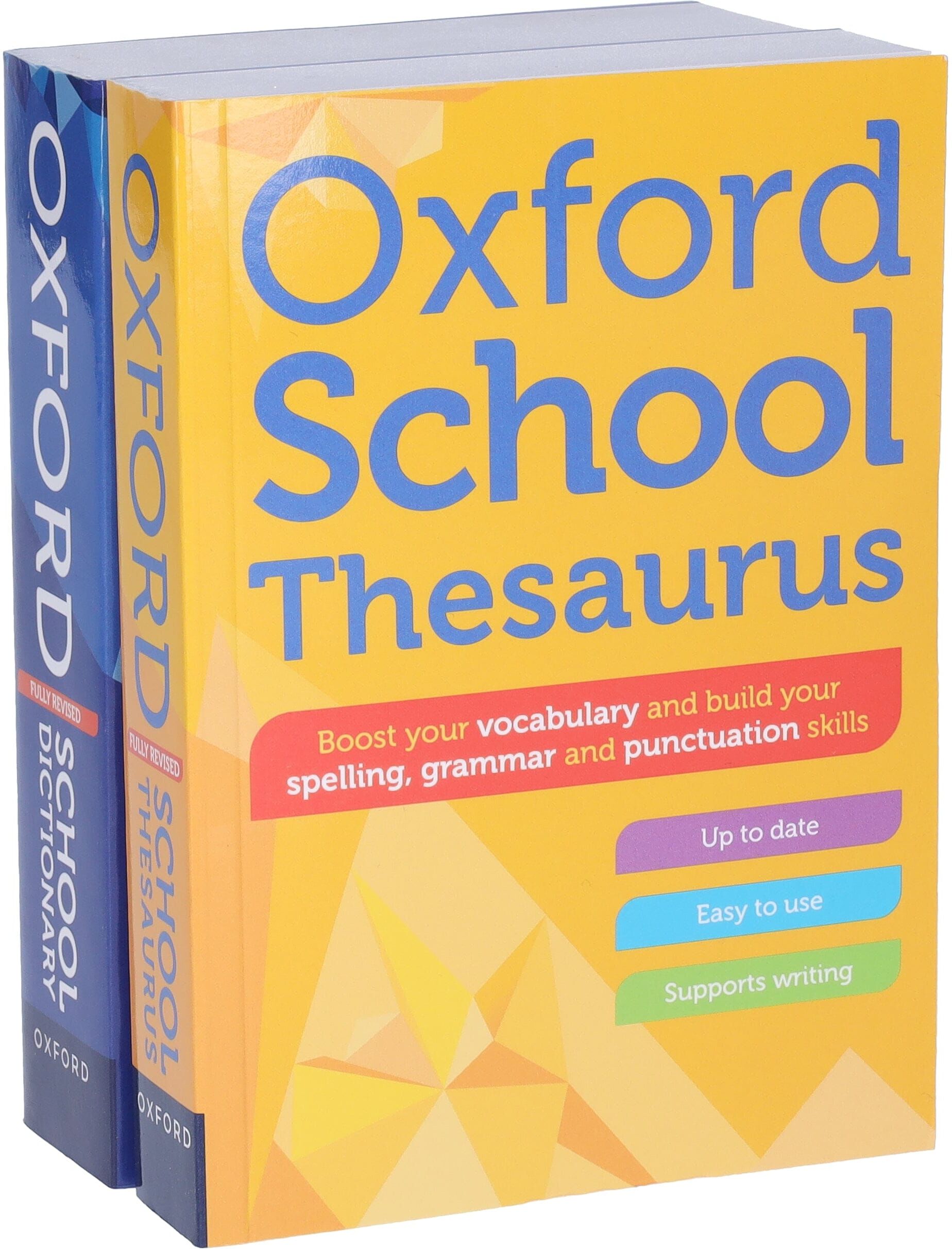
Oxford School Dictionary and Thesaurus 2 Books Collection Set - Non-Fiction - Paperback Oxford University PressThe Oxford School Dictionary and Thesaurus is an essential reference tool for students in primary and secondary education. The dictionary and thesaurus are combined into a single volume, making it an efficient and practical resource for students to use. The Oxford School Dictionary and Thesaurus is designed to provide young learners with the skills necessary to improve their reading and writing skills. The dictionary section of the book contains over 40,000 words, phrases, and definitions. The words are presented in alphabetical order, with clear and concise definitions that are easy for students to understand. Each entry includes a part of speech, a pronunciation guide, and example sentences to provide context for the word's usage. The dictionary also includes important information about word origins, prefixes, suffixes, and spelling rules to help students expand their vocabulary and language skills. One of the most significant benefits of the Oxford School Dictionary and Thesaurus is the inclusion of a thesaurus section. The thesaurus contains over 50,000 synonyms and antonyms, making it an invaluable tool for students looking to improve their writing skills. The thesaurus section is arranged in alphabetical order, making it easy for students to find the word they are looking for. The thesaurus also includes example sentences to provide context for the synonyms and antonyms and help students understand how to use them effectively. The Oxford School Dictionary and Thesaurus also include a range of additional features designed to support and enhance students' learning experience. The book contains a reference section with essential information on grammar, punctuation, and spelling. This section provides clear and concise explanations of essential language rules and guidelines, helping students to develop a strong foundation in English language skills. Another helpful feature of the Oxford School Dictionary and Thesaurus is the inclusion of word histories and language notes. These sections provide fascinating insights into the origins of words and how they have evolved over time. This information not only enhances students' understanding of language but also encourages an interest in language and its development. The Oxford School Dictionary and Thesaurus are designed with students in mind, with clear and easy-to-read text, helpful illustrations, and a durable hardback cover. The book is easy to navigate, with clear cross-referencing between the dictionary and thesaurus sections, making it a user-friendly tool for students to use. The Oxford School Dictionary and Thesaurus is an excellent resource for students of all ages and levels of ability. Whether students are just beginning to learn English or looking to improve their language skills, this book provides a wealth of information and support to help them achieve their goals. The book is particularly useful for students preparing for exams or assessments, as it provides essential information on...14,49 £*Shipping: 2,99 £Secure redirect to the provider
-
The Dog Encyclopedia: The Definitive Visual Guide (DK Pet Encyclopedias)Explore the history and variety of our most faithful companions in this collection of over 400 different dog breeds. For centuries, dogs have been adored for their unswerving loyalty, and this new edition of The Dog Encyclopedia perfectly celebrates the special relationship that binds humans with our four-legged friends. Starting with their history, evolution, and anatomy, this brilliant book about dogs puts on a show of dogs in art and advertising, sport and service, and religion and culture, as famous dogs in fiction line up alongside heroic helpers. The catalogue introduces more than 400 dog breeds arranged in traditional categories, from primitive and working dogs to companion dogs and scent hounds. Every entry includes glorious photographs and fact-packed profiles detailing the individual character, compatible owner traits, and breed-specific advice. Dive straight into this dog book, which offers:- A fully-illustrated guide to canine anatomy and body systems. - A catalogue of internationally recognized dog breeds. - Annotated images that highlight the typical characteristics of every featured breed. - Boxed topics on record breakers, canine film stars, and heroic war dogs add a fascinating degree of detail. Additionally, the book offers expert information on everything from exercising and feeding your dog to grooming and puppy training, along with a section on care to help you identify and deal with any canine health problems. Combining fabulous photographs with information on the latest breeds, historical facts, and advice on everyday care, The Dog Encyclopedia is an indispensable owner's guide and a useful reference for professionals.16,99 £*Shipping: 2,99 £Secure redirect to the provider
-
OXFORD UNIVERSITY PRESS Oxford School Dictionary - Oxford DictionaryOxford School Dictionary Description A major new edition of the trusted; bestselling; comprehensive Oxford School Dictionary with new curriculum support. This fantastic new edition will boost your children's vocabulary with new words and meanings from across the curriculum. A helpful new spelling; grammar and punctuation section is included to enhance language skills and bring the dictionary up to date. What makes it the best? It is uniquely powered by the Oxford Children's Corpus; the largest bank of children's language in English; so you can be confident that all entries are clearly written in child-friendly language that children actually understand. Each example is perfectly age-appropriate; making it easy and enjoyable for every child to use. New for this edition is a robust supplement on spelling; grammar and punctuation; giving targeted help with the tricky bits; making this dictionary the perfect tool to support children in their journey to become good readers and writers. As usual; it has been extensively trialled with schools; so you can be sure it is still the best dictionary for your children; in a handy pocket-sized format7,99 £*Shipping: 2,99 £Secure redirect to the provider
-
How can adverbial clauses be transformed into adverbial phrases?
Adverbial clauses can be transformed into adverbial phrases by removing the subject and verb of the clause and keeping only the modifying words. This results in a shorter phrase that still conveys the same information as the original clause. For example, the adverbial clause "When the sun sets" can be transformed into the adverbial phrase "At sunset." This transformation helps to simplify sentences and make them more concise. **
-
What are adverbial clauses and what are adverbial determinations? Help!
Adverbial clauses are groups of words that function as adverbs in a sentence, providing information about time, place, manner, or reason. They often begin with subordinating conjunctions such as "when," "where," "how," or "why." Adverbial determiners, on the other hand, are words or phrases that modify a verb, adjective, or other adverb by providing additional information about time, frequency, degree, or manner. They can include words like "often," "very," "soon," or "almost." Both adverbial clauses and adverbial determiners help to add detail and specificity to a sentence. **
-
How can adverbial phrases be used instead of adverbial clauses?
Adverbial phrases can be used instead of adverbial clauses to provide additional information about the verb, adjective, or adverb in a sentence. Adverbial phrases are often shorter and more concise than adverbial clauses, making them a more efficient way to convey the same information. For example, instead of saying "When the sun sets, we will go for a walk," you can use the adverbial phrase "At sunset, we will go for a walk." This simplifies the sentence while still conveying the same time-related information. **
-
How do you transform adverbial determinations into adverbial clauses? Please help.
To transform adverbial determinations into adverbial clauses, you need to add a subject and a verb to the adverbial determination. For example, the adverbial determination "after the party" can be transformed into the adverbial clause "after we left the party." This transformation allows the adverbial determination to function as a complete clause within a sentence. Additionally, you may need to adjust the tense and structure of the adverbial determination to fit the context of the sentence. **
Similar search terms for Adverbial
-
DK German English Illustrated Dictionary: A Bilingual Visual Guide to Over 10,000 German Words and PhrasesLearn more than 10,000 of the most useful words and phrases in German with this beautifully illustrated dictionary for German-language students. Building on the success of the English for Everyone course books and the Bilingual Visual Dictionary series, the German English Illustrated Dictionary uses crystal-clear illustrations to show the meaning of over 10,000 words of German vocabulary. The words are shown in a visual context in themed sections covering practical or everyday topics (such as shopping, food, or study), providing learners with all the vocabulary they need for work, travel, and leisure. Fancy becoming an expert in the language? Then open the pages of this German dictionary to discover:- A comprehensive guide to a wide range of useful German words and expressions. - Structured in clear sections based around a theme (e.g. sports, food and drink, transport). - Clear, attractive illustrations make the vocabulary easy to understand and remember. - Includes a beautiful illustration at the start of the section that sets the theme in context. German English Illustrated Dictionary is incredibly easy to use and can be used for self-study or as a reference in the classroom, and is suitable for learners at all levels, from beginner to advanced. Learning German vocabulary has never been easier with this visually stunning dictionary!12,99 £*Shipping: 2,99 £Secure redirect to the provider
-
OUP Oxford Oxford First Thesaurus: An illustrated thesaurus for children age 5+ (Oxford First Dictionaries)Help children build confident speaking and writing skills with the Oxford First Thesaurus - a vibrant, child-friendly thesaurus designed especially for ages 5 and up. Perfect for use at home or in the classroom, it supports early language development by encouraging children to explore new and adventurous vocabulary in a fun, accessible way. Key features include: • Perfect for ages 5+: Developed specifically for young learners to build early speaking and writing confidence • Supports vocabulary growth: Age-appropriate example sentences help children understand synonyms in real-life context • Engaging full-colour illustrations: Bright, 3D artwork helps bring vocabulary to life and makes learning fun • Easy to navigate: Clear alphabetical layout with alphabet thumb tabs and easy-to-use index so children can independently find the words they need • Powered by the Oxford Children's Corpus: Created using a database of real examples of children's writing ensure natural, relevant vocabulary • Perfect classroom or home companion: Works seamlessly alongside the Oxford First Dictionary (9781382076487) for complete early-language support6,99 £*Shipping: 2,99 £Secure redirect to the provider
-
OXFORD UNIVERSITY PRESS Oxford First ThesaurusThis major new edition of the Oxford First Thesaurus in paperback has been updated to include more related words; synonyms and antonyms to develop children's writing skills; support comprehension and inspire a more creative and adventurous use of language. With its accessible alphabetical layout; fun colourful illustrations and relevant example sentences; it is the perfect resource for home and school to boost vocabulary and spark creative writing skills. Also available in durable hardback format and an ideal companion to the new updated edition of the Oxford First Dictionary6,90 £*Shipping: 2,99 £Secure redirect to the provider
-
DK Pet Encyclopedias 2 Books Collection Set Horse Encyclopedia, Dog EncyclopediaDK Pet Encyclopedias 2 Books Collection Set Horse Encyclopedia, Dog Encyclopedia Description The Horse Encyclopedia From tiny ponies to heavy draught horses and rapid thoroughbreds, explore the history and variety of this noble animal that helped shape human history. A stunning celebration of the equine world, The Horse Encyclopedia is a fully illustrated book about horses and ponies, featuring over 150 breeds and types, including all those recognized by national horse societies. First domesticated around 6000 years ago, horses rapidly became invaluable to humans. They pulled chariots and ploughs, and became essential to transport and war. In this comprehensve volume, you will discover breeds from all over the world, from imposing Shires whose ancestors carried knights in chainmail into battle, to thoroughbreds bred to run like the wind, and Lipizzanas that can execute exquisite dressage moves such as the capriole where they jump with all four feet off the ground. The Horse Encyclopedia gives concise details of each breed, including its origins and anatomy, as well as famous individuals such as Secretariat, who is widely regarded as one of the greatest racehorses of all. This dazzling guide also includes expert advice on horse care, feeding and grooming, and horse health, making this a truly wonderful gift for all horse riders and equine enthusiasts. The Dog Encyclopedia : The Definitive Visual Guide Explore the history and variety of our most faithful companions in this collection of over 400 different dog breeds. For centuries, dogs have been adored for their unswerving loyalty, and this new edition of The Dog Encyclopedia perfectly celebrates the special relationship that binds humans with our four-legged friends. Starting with their history, evolution, and anatomy, this brilliant book about dogs puts on a show of dogs in art and advertising, sport and service, and religion and culture, as famous dogs in fiction line up alongside heroic helpers. The catalogue introduces more than 400 dog breeds arranged in traditional categories, from primitive and working dogs to companion dogs and scent hounds. Every entry includes glorious photographs and fact-packed profiles detailing the individual character, compatible owner traits, and breed-specific advice. Dive straight into this dog book, which offers:- A fully-illustrated guide to canine anatomy and body systems. - A catalogue of internationally recognized dog breeds. - Annotated images that highlight the typical characteristics of every featured breed. - Boxed topics on record breakers, canine film stars, and heroic war dogs add a fascinating degree of detail. Additionally, the book offers expert information on everything from exercising and feeding your dog to grooming and puppy training, along with a section on care to help you identify and deal with any canine health problems. Combining fabulous photographs with information on the latest breeds, historical facts, and advice on everyday care, The...24,99 £*Shipping: 2,99 £Secure redirect to the provider
-
What are adverbial particles?
Adverbial particles are words that are used to modify verbs, adjectives, or other adverbs. They are often used to indicate direction, location, or manner. In English, adverbial particles are commonly used in phrasal verbs, where they are combined with a verb to create a new meaning. For example, in the phrasal verb "look up," the adverbial particle "up" modifies the meaning of the verb "look." **
-
What is the difference between formulating an adverbial clause as an adverbial phrase and formulating an adverbial phrase as an adverbial clause? Aren't they the same thing?
Formulating an adverbial clause as an adverbial phrase involves expressing a clause (a group of words containing a subject and a verb) as a single adverbial phrase, typically by removing the subject and verb. On the other hand, formulating an adverbial phrase as an adverbial clause involves expanding a phrase (a group of related words without a subject and verb) into a full clause by adding a subject and verb. While both adverbial clauses and adverbial phrases serve to modify verbs, adjectives, or other adverbs, they are not the same thing due to their structural differences and the presence or absence of a subject and verb. **
-
How do adverbial clauses work?
Adverbial clauses function as adverbs within a sentence, providing information about time, place, manner, condition, purpose, or reason. They often begin with subordinating conjunctions such as "when," "where," "how," "if," "because," and "although." These clauses can modify verbs, adjectives, or other adverbs, adding detail and context to the main clause. Adverbial clauses can be placed at the beginning, middle, or end of a sentence, and they help to connect ideas and show the relationship between different parts of a sentence. **
-
What is an instrumental adverbial?
An instrumental adverbial is a type of adverbial that provides information about the means or instrument used to perform an action. It answers the question "how?" or "by what means?" For example, in the sentence "She cut the vegetables with a knife," the adverbial phrase "with a knife" is instrumental, indicating the tool used to perform the action of cutting. Instrumental adverbials are important for providing additional details about the action being described. **
* All prices are inclusive of VAT and, if applicable, plus shipping costs. The offer information is based on the details provided by the respective shop and is updated through automated processes. Real-time updates do not occur, so deviations can occur in individual cases. ** Note: Parts of this content were created by AI.